Recent data from China’s Ministry of Transport signals a seismic shift in the industry's asset landscape. By December 2025, the nation has retired over 250,000 commercial diesel trucks (National III and IV standards), alongside 450-plus new locomotives and roughly 12,000 decommissioned vessels. These macro figures point to a far more profound trend: a massive, state-led asset divestment.
The Pareto Principle defines this phenomenon. While 80% of market observers dismiss these moves as routine environmental compliance, a savvy 20% recognize a deeper positivist logic. We are witnessing a massive migration of production tools from China’s domestic pool into the global secondary market.
This policy-induced replacement cycle has flooded the market with high-quality used assets. Crucially, the exit of these 250,000 trucks stems from shifting administrative thresholds rather than mechanical failure. For overseas operators prioritizing Return on Investment (ROI), this creates a rare and lucrative window for capital arbitrage.
Stripped of their book value through aggressive depreciation, these retired units remain formidable production tools. Their primary appeal lies in a radical reduction of initial capital expenditure, offering expansion-oriented firms a significantly compressed payback period.
Prudent decision-makers must look beyond the "used" label. In commerce, utility is the only truth. Any asset capable of generating sustained cash flow relative to its residual value is, by definition, a high-quality asset. Empirical evidence confirms the structural integrity of this Chinese fleet, backed by a mature supply chain that guarantees minimal maintenance overheads.
As policy continues to drive this supply expansion, it evolves from a localized trade opportunity into a structural trend in global asset reallocation.
For the discerning buyer, the objective is quantitative: isolating the "top 20%" of assets with the highest residual value. Success requires stripping away emotional brand premiums and focusing relentlessly on wear rates, serviceability, and marginal operating costs per shipment.
Value resides in functional utility—and in this current wave of replacement, that utility is being traded at a deep discount.
The headline figure—over 250,000 commercial diesel trucks retired in China—represents more than just a regulatory milestone; it signals a massive opening for global capital. To capture the value within this surge of discarded assets, one must look beyond the surface of "scrapped equipment" to identify the specific nodes of profitability.
The primary opportunity lies in the price-to-performance disconnect. Because these vehicles are being pushed out by administrative mandates (the transition to stricter emission standards) rather than mechanical failure, their functional utility remains intact. This creates a high-yield entry point for operators in developing markets or logistics firms with less stringent immediate emission requirements, allowing them to acquire robust workhorses at a fraction of the cost of new fleet additions.
Furthermore, the scale of the supply chain provides a secondary advantage. The sheer volume of these standardized trucks—predominantly from major Chinese manufacturers—means that the global market is now being flooded with compatible spare parts. For a buyer, this ensures that the "total cost of ownership" remains low, as maintenance is supported by an existing, mature logistics network for components.
Lastly, the opportunity is a quantitative selection play. The market is currently inefficient; many sellers are looking for quick divestment, often mispricing high-residual-value units. For those who can deploy rigorous inspection and data-driven screening, the potential for capital arbitrage is immense—buying undervalued, high-utility assets in China and redeploying them where their marginal productivity is highest.
Vehicle Recommendation:
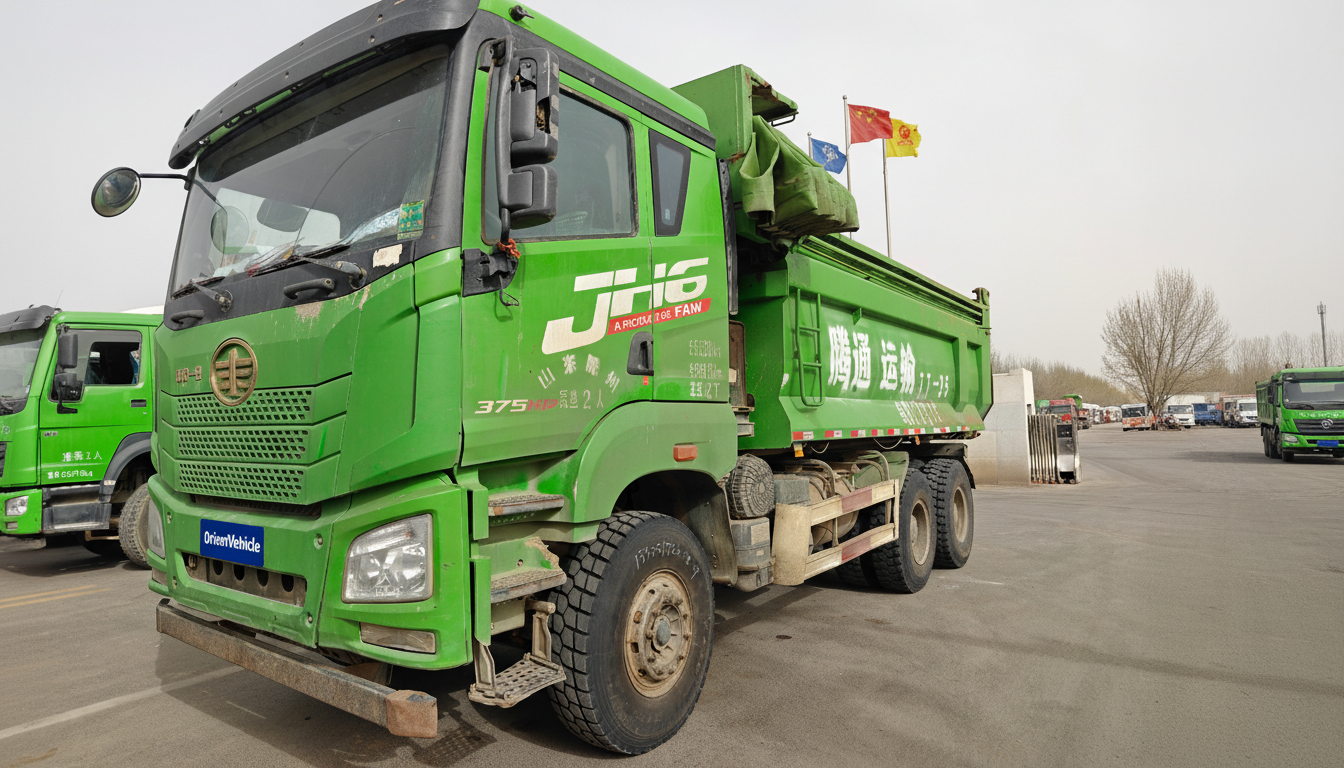
High-quality used dump trucks